If you work in export, import, international shipping, logistics, freight forwarding or supply-chain planning, understanding CBM is important. CBM tells you how much physical volume your packed cargo occupies and helps you plan shipment space.
This complete CBM Calculator Guide explains the CBM full form, Cubic Meter meaning, CBM formula, how to calculate CBM, how to calculate CBM from cm, total shipment CBM, CBM to KG, CBM to CFT, container capacity and practical shipment examples.
For a quick calculation, use the Free CBM Calculator on ExportImportTools. It can help calculate shipment volume and related planning measurements without doing every calculation manually.
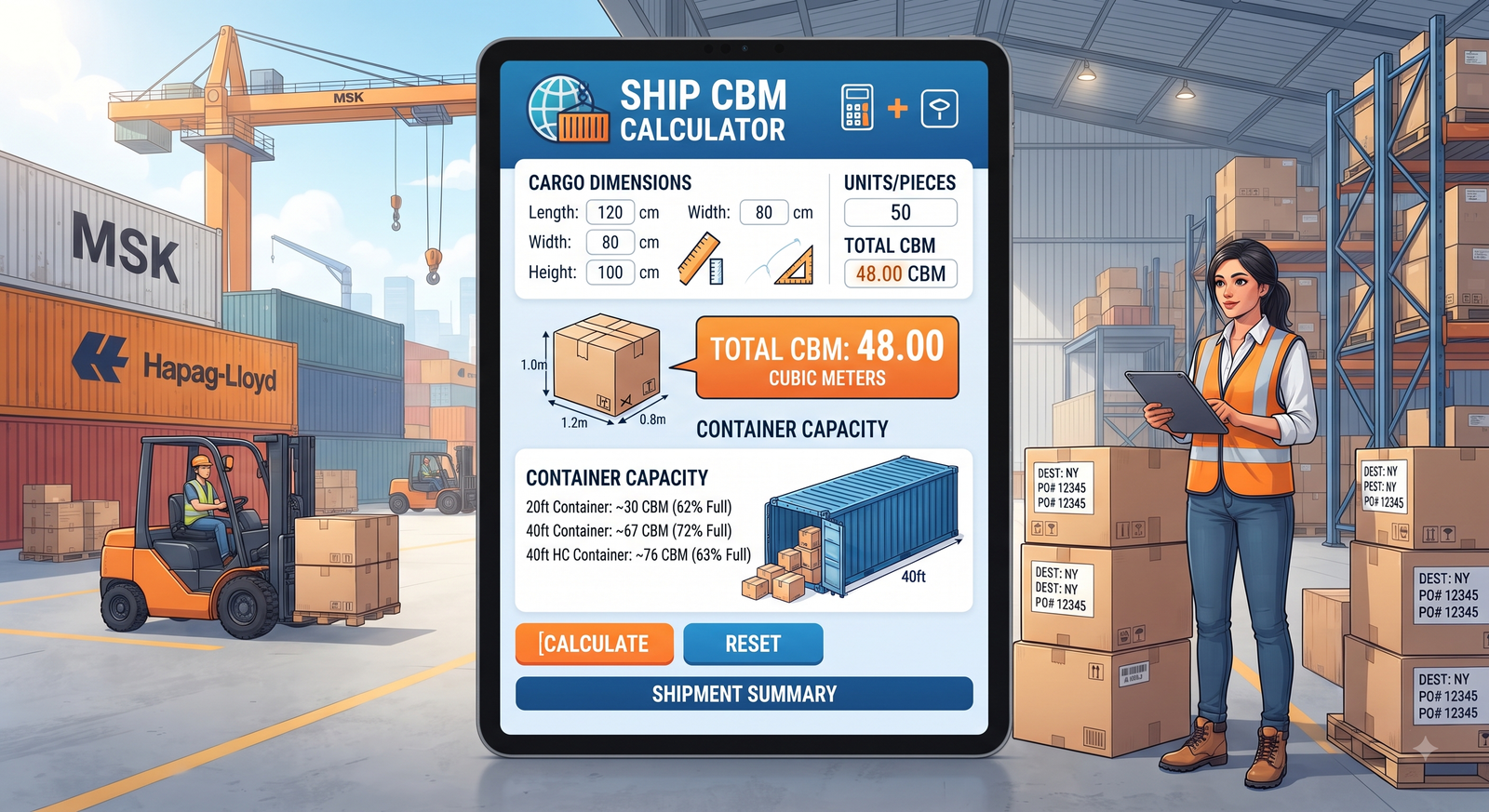
What is CBM in Shipping?
CBM stands for Cubic Meter. A cubic meter is a unit of volume equal to 1 meter × 1 meter × 1 meter. In international shipping, CBM is commonly used to describe the volume occupied by cartons, boxes, pallets, crates and other packed cargo.
For example, if an exporter has 100 identical cartons, the CBM of one carton can be calculated first and then multiplied by 100 to estimate the total shipment volume.
How to Calculate CBM
The basic CBM calculation is simple. Convert the package dimensions to meters and multiply length, width and height.
For multiple identical cartons:
Example: One Carton
Suppose a carton measures 0.50 m × 0.40 m × 0.30 m.
Therefore, one carton occupies approximately 0.06 cubic meter.
Example: 100 Cartons
The estimated total shipment volume is 6 CBM.
How to Calculate CBM from Centimeters
Carton dimensions are often provided in centimeters, especially on packing lists and commercial shipment documents. You can calculate CBM directly from centimeters.
CBM from cm Example
- Length = 50 cm
- Width = 40 cm
- Height = 30 cm
So the carton volume is 0.06 CBM.
How to Calculate Total CBM for Multiple Cartons
If all cartons have the same dimensions, calculate one carton and multiply by the quantity.
One carton: 0.06 CBM
Quantity: 100 cartons
Total: 0.06 × 100 = 6 CBM
If a shipment contains different carton sizes, calculate each carton size separately and add the results.
20 cartons × 0.05 CBM = 1.00 CBM
30 cartons × 0.08 CBM = 2.40 CBM
10 cartons × 0.12 CBM = 1.20 CBM
Total shipment volume = 4.60 CBM
CBM Calculator for Export and Import
A CBM Calculator is useful for exporters, importers, freight forwarders, sourcing companies, manufacturers and logistics professionals. Instead of repeatedly applying the CBM formula by hand, you can enter package dimensions and quantity to estimate the shipment volume.
For users searching for a CBM Calculator India or CBM Calculator for export and import, the same cubic-meter formula applies. The calculation does not change because the shipment is in India; what can change are the freight carrier's measurement, rate and chargeable-weight rules.
Need to calculate your shipment CBM?
Enter your package dimensions and quantity in the free online calculator.
Calculate CBM NowHow to Calculate CBM to KG
One important point is that CBM and KG are not the same measurement. CBM measures volume, while KG measures mass. There is no single universal CBM-to-KG conversion for every product.
For example, water has a density close to 1,000 kg per cubic meter, so 1 CBM of water is approximately 1,000 kg. A different product can have a much lower or higher density.
CBM to CFT Conversion
CBM means cubic meter and CFT means cubic feet. Both measure volume.
Example: 10 CBM to CFT
So 10 CBM is approximately 353.15 CFT.
CBM and Volumetric Weight
Volume and volumetric weight are related but are not identical. Volumetric weight converts package dimensions into a weight value used by some transportation services when cargo is large relative to its actual weight.
Air Freight Volumetric Weight
A commonly used air-freight planning formula is:
For a 60 × 50 × 40 cm carton:
The applicable divisor can vary by carrier, service and route, so confirm the current carrier rule before using volumetric weight for a freight quotation.
20FT, 40FT and 40FT HC Container CBM Capacity
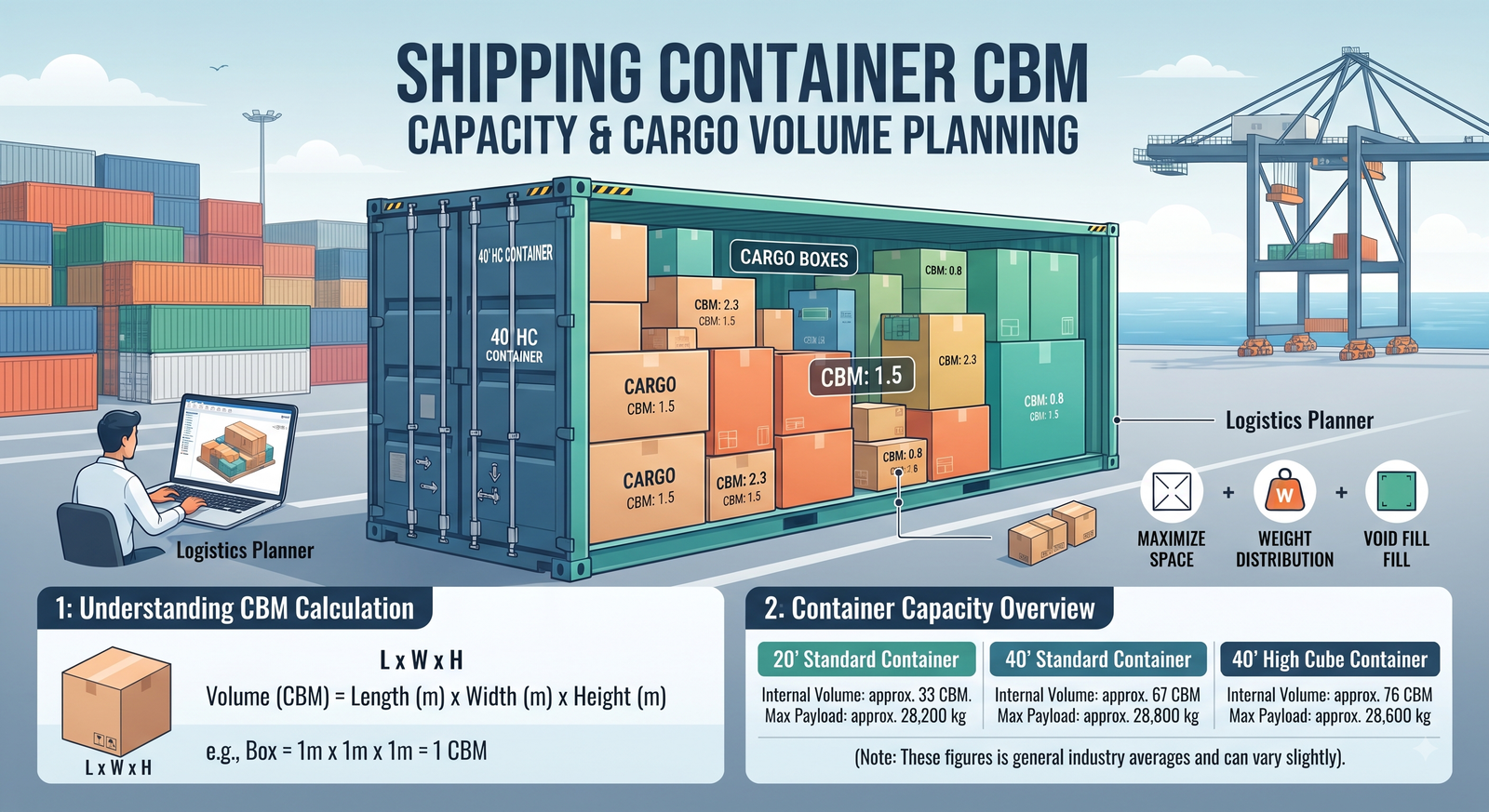
CBM is particularly important when planning ocean freight. Common dry-container sizes include 20FT, 40FT and 40FT High Cube (HC). Their theoretical internal volumes are often discussed as approximate planning figures, but the cargo you can actually load may be lower.
20FT container: roughly 33 CBM theoretical internal volume
40FT container: roughly 67 CBM theoretical internal volume
40FT HC container: roughly 76 CBM theoretical internal volume
Actual loading depends on carton dimensions, cargo shape, pallets, loading method, packaging gaps, maximum payload and the carrier's requirements. Therefore, container CBM figures should be treated as planning estimates, not guaranteed loading quantities.
CBM for LCL and FCL Shipping
CBM is especially useful when comparing LCL (Less than Container Load) and FCL (Full Container Load) shipment planning. LCL shipments commonly use cargo volume as one of the important inputs for freight calculations, while FCL planning focuses on how the cargo fits within the selected container and its weight limits.
The exact freight calculation is determined by the logistics provider, route, commodity, shipping terms and quotation. CBM is therefore an important planning measurement, but it is not itself a freight quote.
Why CBM is Important in Export Business
- Estimate total shipment volume.
- Plan container space.
- Prepare cargo details for freight forwarders.
- Compare LCL and FCL planning requirements.
- Prepare packing lists and shipment information.
- Estimate space requirements before requesting freight rates.
- Improve export packing and loading planning.
- Reduce manual errors in shipment calculations.
Common CBM Calculation Mistakes
1. Mixing Measurement Units
Do not mix centimeters, meters, inches and feet in the same calculation. Convert all three dimensions to the same unit first.
2. Using Product Dimensions Instead of Packed Dimensions
The product can be smaller than the export carton. For shipment-space planning, use the outside dimensions of the packed cargo.
3. Forgetting Quantity
The CBM of one carton is not the total shipment CBM. Multiply the volume of one identical carton by its quantity.
4. Ignoring Different Carton Sizes
For mixed carton sizes, calculate each size separately and add the results.
5. Treating Theoretical Container Volume as Practical Capacity
Theoretical container volume does not mean every cubic meter can be perfectly filled. Loading gaps, carton geometry, pallets and weight restrictions affect practical utilization.
6. Assuming CBM Always Converts to 1,000 KG
CBM is volume, not mass. A CBM-to-KG result requires the density or the specific freight-rating rule applicable to the cargo.
How to Calculate CBM Before Booking a Shipment
- Measure the outside length of each packed package.
- Measure the outside width.
- Measure the outside height.
- Confirm the measurement unit.
- Calculate the CBM of one package.
- Multiply by the quantity for identical packages.
- Calculate different carton sizes separately.
- Add all carton volumes together.
- Compare the result with your planned shipping method and container.
- Confirm the final freight measurement and chargeable rules with the carrier or freight forwarder.
CBM Calculator for India and International Trade
If you are an Indian exporter or importer, a CBM Calculator India can be useful for preparing shipment information before contacting a freight forwarder. The underlying CBM formula remains the same: length × width × height, with the dimensions converted into meters.
For international shipments, also keep the following information ready: carton quantity, packed dimensions, gross weight, net weight where applicable, pallet details and product description. This makes it easier to discuss LCL, FCL, air-freight or other transportation options.
Free CBM Calculator
If you regularly handle export or import shipments, manually calculating every carton can become time-consuming. Use the ExportImportTools CBM Calculator to calculate shipment volume from package dimensions and quantity.
Calculate CBM, CFT and shipment measurements online.
Open Free CBM CalculatorPeople Also Ask: CBM Questions
What is 1 CBM in shipping?
1 CBM is 1 cubic meter of cargo volume. It is a volume measurement used in shipping and logistics.
What does CBM mean?
CBM means Cubic Meter, a unit used to measure three-dimensional volume.
How do you calculate CBM?
Multiply length × width × height after converting the dimensions to meters. For identical cartons, multiply the result by quantity.
Is CBM equal to m3?
Yes. CBM means cubic meter, and m³ is the standard symbol for cubic meter.
How many CBM is a 40FT container?
A standard 40-foot dry container has a theoretical internal volume of roughly 67 CBM. Practical cargo capacity can be lower depending on loading conditions.
How many CBM is a 40FT High Cube container?
A 40FT High Cube container has a theoretical internal volume of roughly 76 CBM. Actual usable volume depends on the cargo and loading plan.
What is CBM full form?
The full form of CBM is Cubic Meter.
How to calculate CBM to KG?
CBM cannot be converted to KG without knowing cargo density. Use weight = volume × density. For water, 1 CBM is approximately 1,000 kg.
What is the difference between CBM and CFT?
CBM is cubic meters and CFT is cubic feet. 1 CBM is approximately 35.3147 CFT.
Can I calculate CBM online?
Yes. You can use an online CBM Calculator to calculate cargo volume from package dimensions and quantity.
Conclusion
CBM calculation is an essential part of export, import and international shipping planning. Once you understand the Cubic Meter concept and the CBM formula, calculating carton and shipment volume becomes straightforward.
Always use accurate outside packed dimensions, the correct measurement unit and the correct quantity. For mixed carton sizes, calculate each package type separately and add the volumes. For CBM-to-KG calculations, use the relevant cargo density or carrier rule rather than assuming a universal conversion.
For a faster calculation, use the Free CBM Calculator and explore the shipping tools available on ExportImportTools.