Most new exporters price their products assuming zero government support — and leave real margin on the table. India runs several export incentive schemes designed to make Indian goods competitive internationally; knowing which ones apply to your product can meaningfully change your landed cost math.
Here's a simple breakdown of the major export subsidy and incentive schemes available in India in 2026.
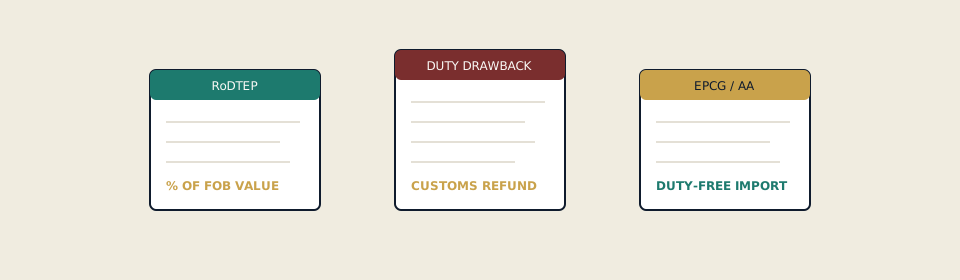
Overview: Major Export Incentive Schemes in India
| Scheme | What It Covers | Best Suited For |
|---|---|---|
| RoDTEP | Refund of embedded, un-refunded duties/taxes on exported goods | Most manufacturer-exporters |
| Duty Drawback | Refund of customs duty paid on imported inputs used in exports | Exporters using imported raw materials |
| Advance Authorisation | Duty-free import of inputs that go into the export product | Exporters who need to import raw materials |
| EPCG | Duty-free import of capital goods for producing export goods | Manufacturers investing in machinery |
| Interest Equalisation Scheme | Reduced interest rate on pre/post-shipment export credit | MSME exporters needing working capital |
1. RoDTEP (Remission of Duties and Taxes on Exported Products)
RoDTEP refunds embedded central, state and local duties/taxes that are not otherwise refunded — like electricity duty, fuel used in transport, and mandi tax — which are otherwise absorbed silently into your export cost. The refund is issued as a transferable duty credit scrip, calculated as a percentage of the FOB value based on the product's HS code.
Use our Duty Drawback / RODTEP Calculator to estimate this for your product.
2. Duty Drawback Scheme
If your export product uses imported raw materials on which customs duty was paid, Duty Drawback refunds that duty once the finished goods are exported. It comes in two forms — an All Industry Rate (a fixed percentage, simpler to claim) and a Brand Rate (calculated specifically for your actual duty paid, useful when the AIR under-compensates you).
3. Advance Authorisation Scheme
This allows duty-free import of inputs that are physically incorporated into the export product (after allowing for normal wastage), subject to fulfilling a specified export obligation within a set time frame. It's especially useful for exporters who depend on imported raw materials or components.
4. EPCG (Export Promotion Capital Goods) Scheme
EPCG allows duty-free import of capital goods (machinery, equipment) used for producing export goods, in exchange for meeting an export obligation — typically a multiple of the duty saved, over a period of years.
5. Interest Equalisation Scheme
This scheme reduces the interest rate on pre-shipment and post-shipment rupee export credit, primarily benefiting MSME exporters and specified sectors, effectively lowering the cost of working capital used to fund production and shipment.
Quick tip: Most schemes require registration and documentation before shipment (e.g. Advance Authorisation, EPCG), while RoDTEP and Duty Drawback are claimed at the time of filing your shipping bill — check the timeline for each scheme before you commit to using it.
How to Choose the Right Scheme for Your Product
- If you manufacture domestically with local inputs → RoDTEP is usually your primary benefit.
- If you import raw materials and pay customs duty on them → compare Duty Drawback vs Advance Authorisation based on your import volume.
- If you're investing in new production machinery → check EPCG eligibility before importing equipment.
- If working capital is tight → check your eligibility under the Interest Equalisation Scheme with your bank.
Estimate your RoDTEP / Duty Drawback benefit now.
Open Duty Drawback / RODTEP CalculatorFrequently Asked Questions
Can I claim both RoDTEP and Duty Drawback on the same shipment?
No, RoDTEP and the standard Duty Drawback scheme are generally mutually exclusive for the same export item — exporters must choose the more beneficial scheme for each product.
Who is eligible for RoDTEP?
Most exporters of goods manufactured in India are eligible, though the scheme excludes certain categories such as goods exported through courier/post in specific cases and products explicitly excluded from the RoDTEP rate schedule.
What is the difference between EPCG and Advance Authorisation?
EPCG allows duty-free import of capital goods used to produce export goods, while Advance Authorisation allows duty-free import of raw materials and inputs that go directly into the export product.
Conclusion
Export incentive schemes exist precisely to keep Indian exports price-competitive — leaving them unclaimed is leaving margin on the table. Identify which schemes apply to your product early, and build them into your export pricing from day one.
Use our Export Price Calculator and Duty Drawback / RODTEP Calculator to build incentive-aware pricing.